Does storytelling actually…work?
Next to generative AI, 'storytelling' is one of the buzziest strategic keywords in marketing these days. You may have found yourself asking one or more of the following questions:
What is it, exactly?
Why does it work?
What brands have done this successfully?
How can I leverage these tactics to drive results for my brand?
Below, Lore demystifies the hype and reveals the proven strategies behind these success stories.
1. What is storytelling?
Storytelling isn't just for fairy tales around a campfire; it's a powerful tool that can ignite connections and drive results for both businesses selling directly to consumers (B2C) and those selling to other businesses (B2B). While the audiences and products might differ, the fundamental human need for connection and understanding through narrative remains constant.
Storytelling started gaining traction with marketing strategists around the 2010s due to:
Content Marketing Boom: The rise of content marketing as a core strategy - due to the influence of digital channels (like social media) - necessitated more engaging and less overtly promotional ways to connect with audiences. Storytelling naturally fit this need.
Digital and Social Media: These platforms provided new avenues for brands to share narratives and interact with consumers on a more personal level.
Increased Consumer Skepticism: As consumers became more resistant to traditional advertising, storytelling offered a way to build trust and emotional connections.
Thought Leadership and Research: Marketing experts and academics began to emphasize the psychological power of narratives in influencing consumer behavior and building brand loyalty.
Storytelling, within the realm of marketing and business strategy, is the deliberate construction and sharing of a narrative that highlights a conflict, transformation, or shared value to emotionally engage an audience and influence their behavior. Let’s break it down:
Deliberate Construction: It's not just a casual anecdote; it is a carefully structured narrative with a beginning, middle, and end (often following a "hero's journey" or "problem-solution" arc).
Conflict, Transformation, or Shared Value:
Conflict: The challenge a customer or client (the hero) faces (e.g., being resistant to traditional advertising, or having inefficient software).
Transformation: How the product or service (the guide) helps the hero overcome the conflict and achieve a better state (e.g., finding confidence, or achieving massive efficiency).
Shared Value: The fundamental human truth or mission that the brand and audience care about (e.g., environmental activism for Patagonia).
Emotionally Engage: The primary goal is to build trust and connection by appealing to the human need for narrative, making the brand feel relatable, authentic, and memorable. This is a vital step in influencing behavior (purchase, loyalty, partnership).
2. Why does this work?
The definition above, ‘The deliberate construction and sharing of a narrative that highlights a conflict, transformation, or shared value to emotionally engage an audience and influence their behavior,’ is built on the following widely recognized principles:
1. Focus on Emotional Connection & Influence:
The Science: Research, including studies by neuroeconomist Paul Zak, has shown that compelling stories can trigger the release of oxytocin (the "bonding hormone"), which fosters trust and empathy. According to a report by Edelman, 63% of consumers say a business story has influenced a purchasing decision in some way.
The Business Impact: This emotional engagement is the fundamental reason storytelling is valued in marketing—it makes a brand memorable and influences purchase decisions more effectively than a list of features or facts. (Forbes: The Power of Storytelling in Modern Marketing).
2. The Narrative Structure (Conflict/Transformation):
Effective storytelling in business should follow the classic narrative arc (beginning, middle, end) which involves a conflict or challenge (the customer's pain point) and a resolution or transformation (the solution provided by the product/service).
This structure is often referred to as the "Hero's Journey" in a marketing context, where the customer is the hero and the brand is the helpful guide. (Harvard Business School: What is a Brand Story?)
3. Shared Value and Authenticity:
The concept of conveying shared value and a deeper purpose is crucial. Companies are increasingly using stories to communicate their mission and values, which builds deeper loyalty.
A study published in the Harvard Business Review found that a significant percentage of consumers who have a relationship with a brand do so because of shared values. (Harvard Business Review: Three Myths About What Consumers Want)
3. What brands have done this successfully?
Below is a snapshot of four different companies that have leveraged storytelling to build a relationship with B2C and B2B audiences. B2B storytelling often focuses on "return on investment (ROI)," "risk mitigation," and "scale," as demonstrated by the Microsoft and Asana results. In contrast, B2C storytelling typically focuses on "emotional connection," "identity and belonging," and "aspiration," as exemplified by the Patagonia and Airbnb narratives."
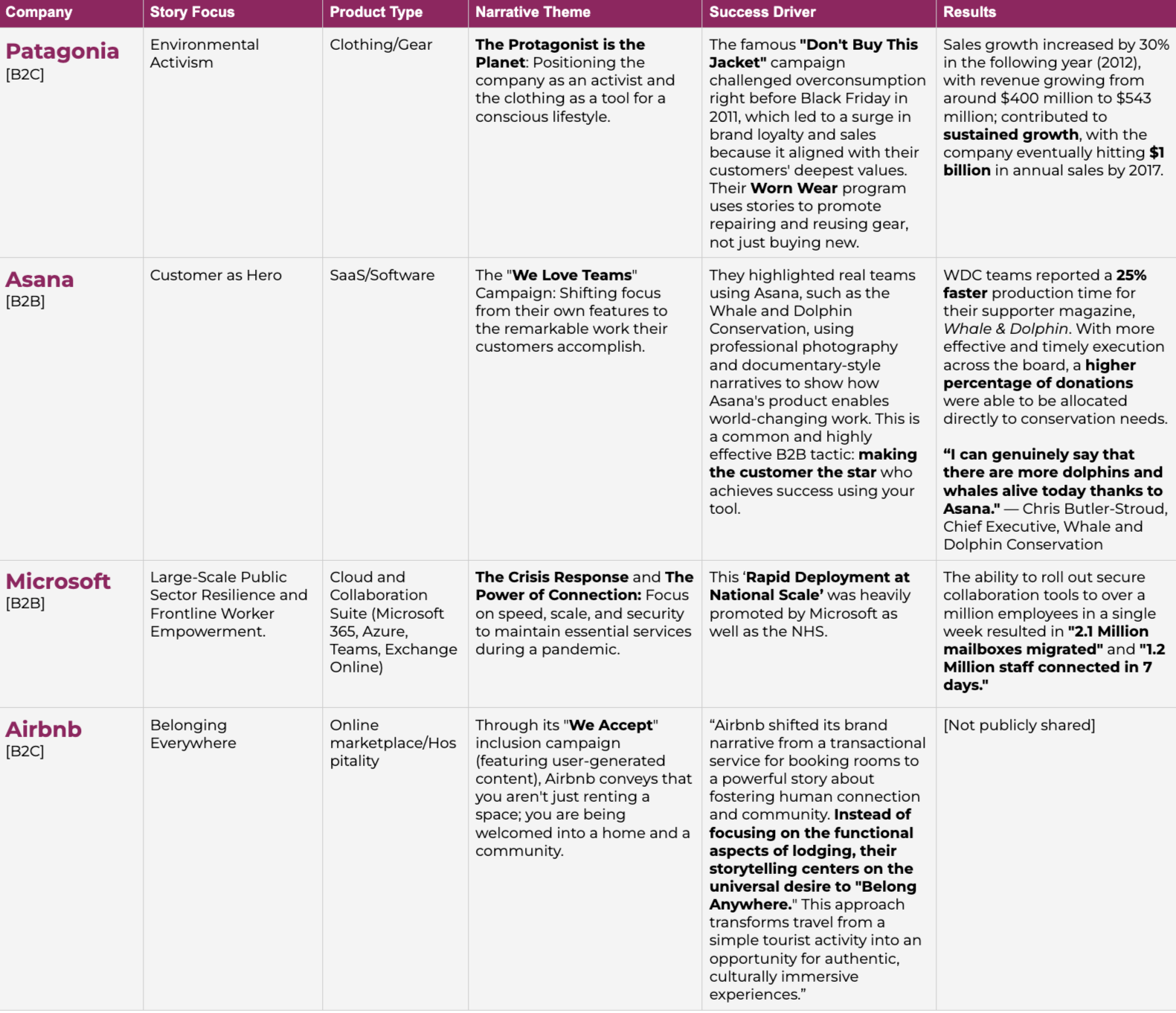
Sources: Patagonia Investopedia: The Success of Patagonia’s Marketing Strategy; Asana Asana; Microsoft (Accenture); Airbnb (The MarCom Society)
4. How can your brand leverage these proven tactics for growth?
The success of Patagonia's anti-marketing and Airbnb's transparency shows the importance of building trust and connection through storytelling. Having a well-formulated story that resonates with your target audience is key. Lore Brand + Marketing is here to help.
Contact Lore today for a complimentary 30-minute strategy session. We'll explore how to apply the concepts above, from turning a challenge into a powerful narrative to designing stories that drive customer loyalty and measurable business growth.